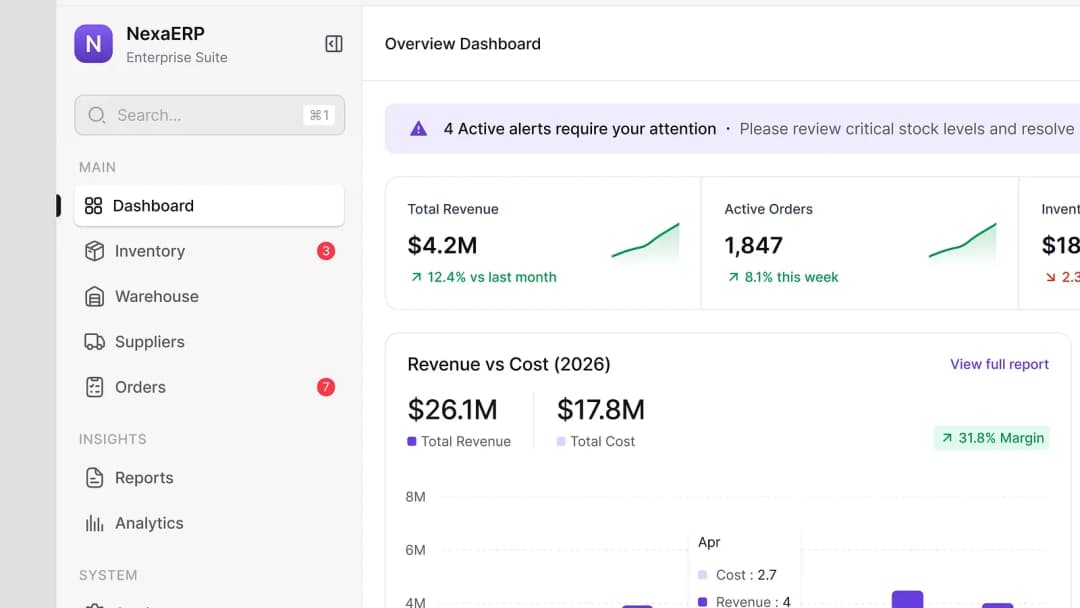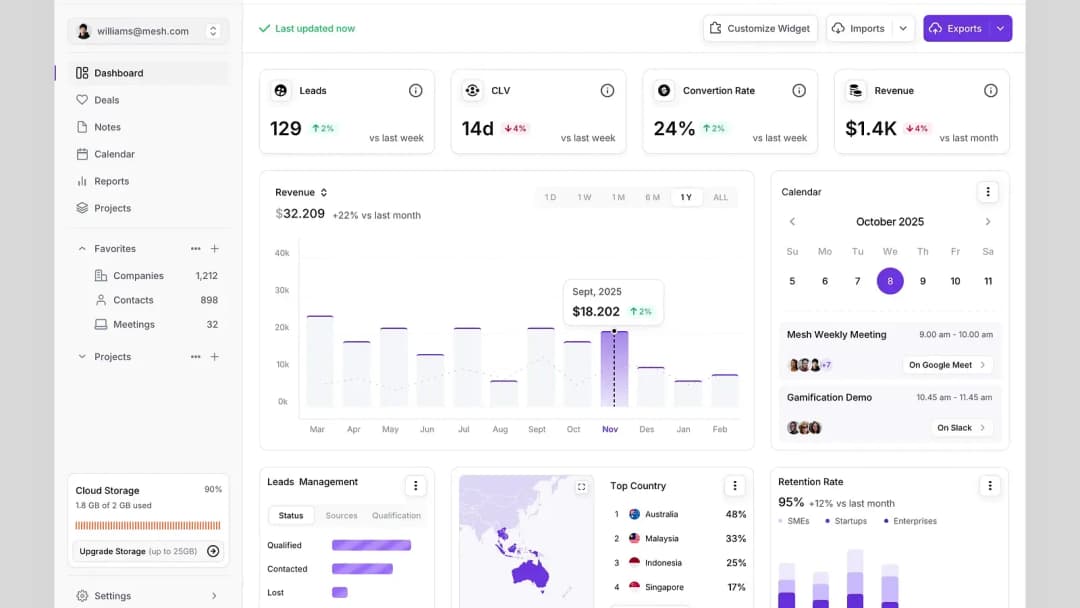
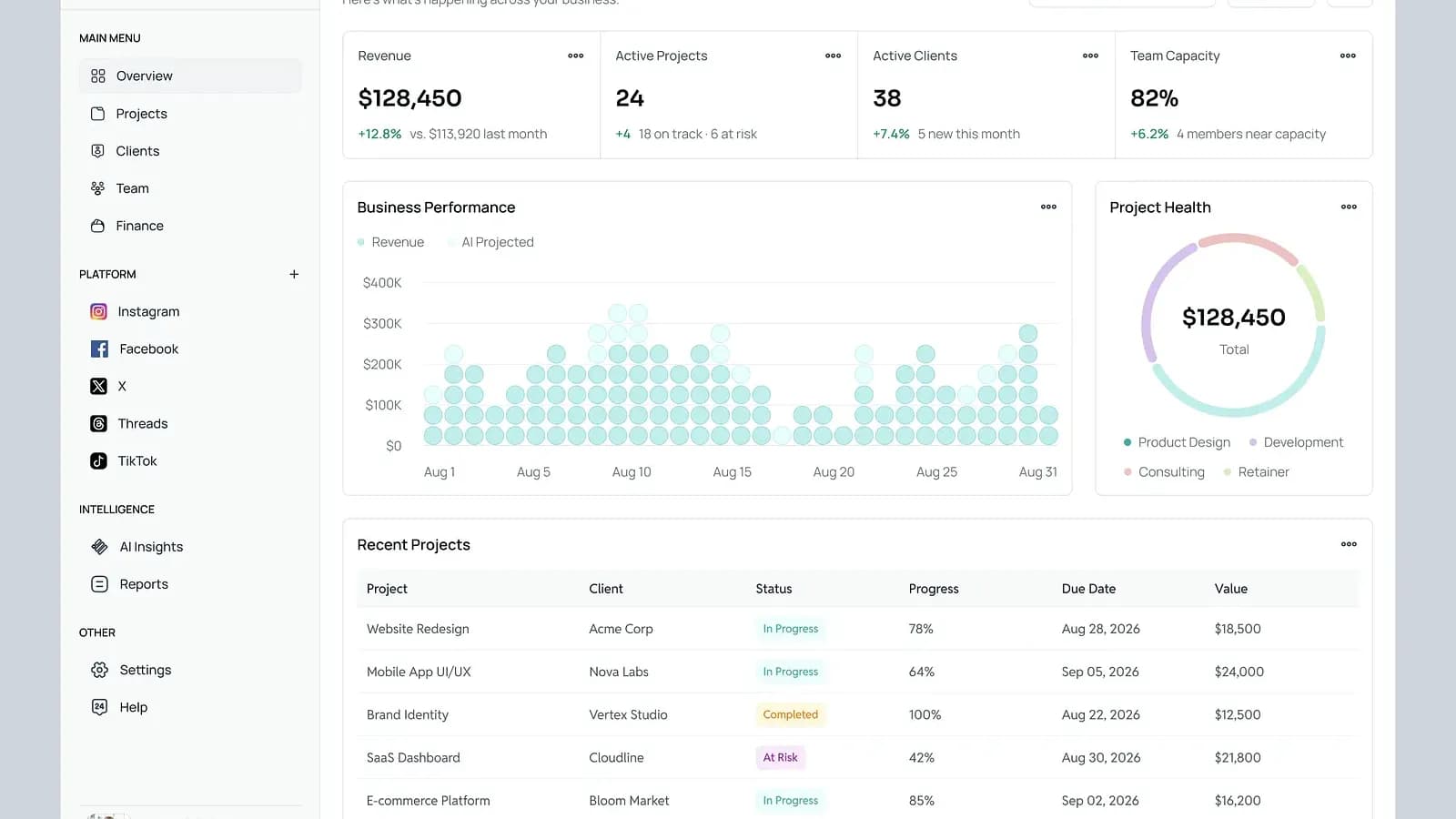
Customers in one place, leads in another, invoices in spreadsheets and projects in different software. Custom business management software gives your company a single source of truth.
Business management software is a web-based platform that combines CRM, sales, projects, finance, vendors, employees and reporting into one system. Custom business management software development in Kerala builds that platform around your actual workflow, so management can see revenue, outstanding invoices, active projects and pending follow-ups without checking five different tools.
- Many tools but no single source of truth is a data problem — one connected system solves it.
- Modules such as CRM, sales, projects, finance, vendors and reports can be combined in one platform.
- A central dashboard replaces manually prepared management reports.
- Automation removes repetitive steps like creating leads, assigning staff and updating balances.
On this page
- What is business management software?
- Why businesses use business management systems
- What can be included?
- Business dashboard
- Custom software development vs generic software
- Web-based business software
- Business management software for Kerala companies
- Automating repetitive business tasks
- Can business software replace multiple applications?
- How custom software development works
- Custom business software development in Kerala
- Build software around your business
- Frequently asked questions
As a business grows, managing daily operations becomes increasingly complicated. Customer information may be stored in one place, leads in another, invoices in spreadsheets and projects in completely different software. This creates a common problem:
The business has many tools, but no single source of truth.
This is where custom business management software can help. A business management system combines important processes such as CRM, sales, projects, finance, customers and reporting into one web-based platform.
What is business management software?
Business management software is a digital platform designed to help a company manage its day-to-day operations. Depending on the business, it can include:
- CRM
- Lead management
- Customer management
- Sales
- Projects
- Tasks
- Vendors
- Inventory
- Invoices
- Expenses
- Payments
- Reports
- Dashboards
Instead of purchasing separate software for every department, businesses can build a system around their actual workflow.
Why businesses use business management systems
Consider a growing company receiving 100 enquiries every month. The sales team tracks leads in Excel. Customer details are stored in WhatsApp. Projects are tracked through messages. Invoices are created separately. Management then asks:
- How many active customers do we have?
- How much revenue is pending?
- Which leads need follow-up?
- Which projects are currently active?
If the answers require checking five different systems, the business has a data problem. A centralised business management application can solve it.
What can be included?
A custom business management system can include multiple modules.
CRM
Manage leads and customers — see our guide to custom CRM software development.
Sales
Manage enquiries, quotations and sales pipelines.
Projects
Track active projects and their progress.
Finance
Track invoices, expenses, payments and outstanding amounts.
Vendors
Maintain vendor information and transactions.
Employees
Manage assignments, tasks and internal activities.
Reports
Generate management reports from the system.
Business dashboard
One of the most useful features is a central dashboard. A management dashboard could display:
- Total revenue
- Outstanding invoices
- Active projects
- New leads
- Converted leads
- Pending follow-ups
- Monthly expenses
- Profit & loss
Instead of manually preparing reports, management can access the information directly from the system.

Custom software development vs generic software
Generic software is built for a broad audience. Custom software is built for a specific business. For example, a standard project management application may provide tasks and deadlines — but a construction company may need:
- Lead
- Site visit
- Quotation
- Approval
- Project
- Invoice
- Payment
A custom system can connect those stages.
Web-based business software
Modern business management systems can be developed as web applications, so employees can access the system through a browser. Depending on its requirements, a company can have:
- Admin dashboard
- Sales dashboard
- Project dashboard
- Finance dashboard
- Customer portal
The system can be hosted on appropriate cloud or server infrastructure and accessed from different locations.
Business management software for Kerala companies
Companies in Kottayam, Changanassery, Kochi, Ernakulam and Kollam can use custom systems to digitise workflows across industries. For example:
Construction companies
Lead management + projects + quotations + customers + finance. See our construction CRM.
Agencies
Leads + clients + projects + invoices + expenses. See our digital agency CRM.
Logistics companies
Customers + bookings + operations + documents + billing. See our logistics CRM.
Educational businesses
Students + enquiries + admissions + fees. See our coaching & EdTech CRM.
Manufacturing
Customers + dealers + enquiries + quotations + orders.
Automating repetitive business tasks
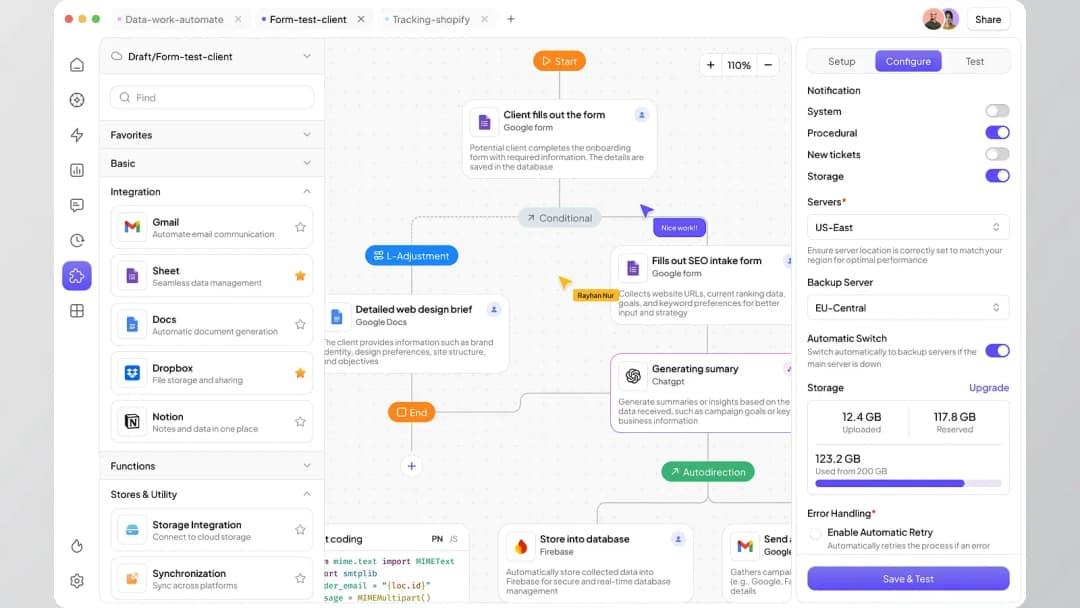
One major benefit of custom software is automation. Instead of employees manually performing repetitive actions, the system can automate certain workflows. For example:
- Create lead
- Assign salesperson
- Send notification
- Create follow-up
- Store invoice
- Update customer balance
- Update outstanding amount
- Add to financial reports
Automation saves time and reduces manual errors — read more in our guide to CRM and business automation.
Can business software replace multiple applications?
Sometimes, yes. However, the goal should not be to replace every application. The goal is to identify where your business loses time because information is fragmented — and then build a custom system around those critical processes.
How custom software development works
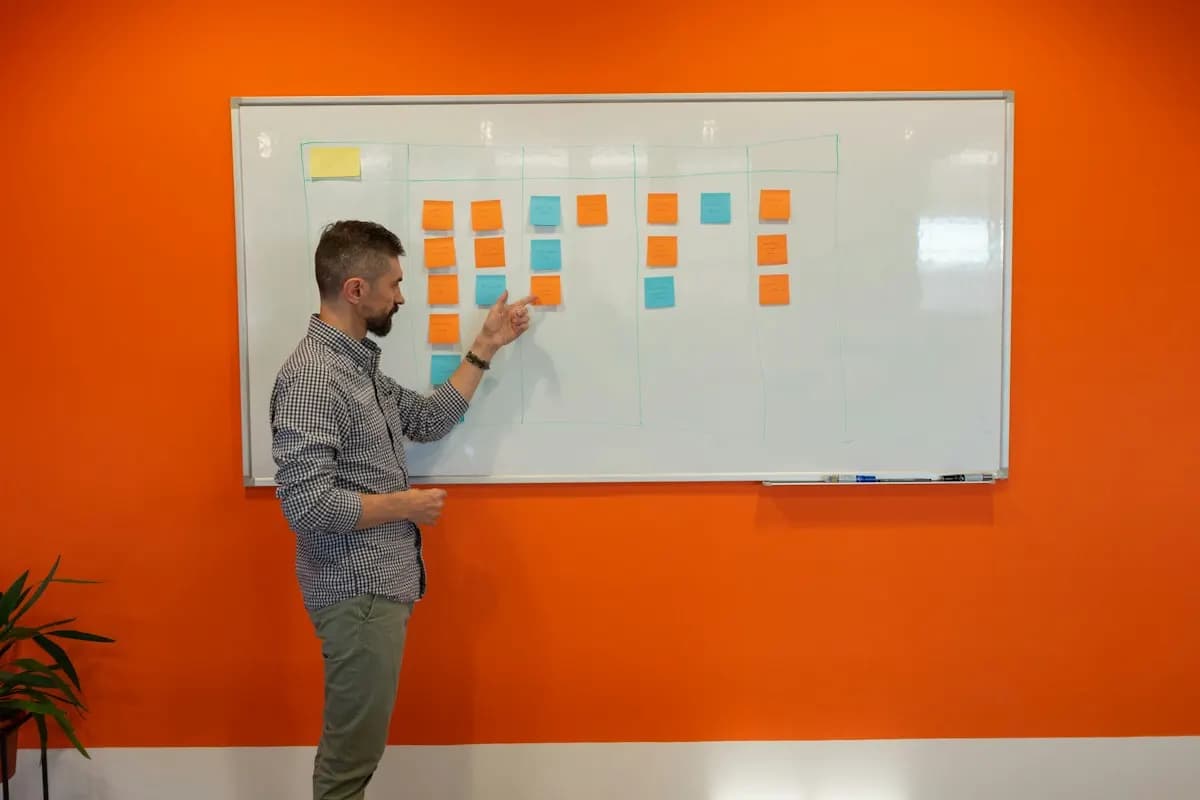
A professional software development project generally follows these stages:
1. Requirement analysis
Understand how your business currently works.
2. Workflow mapping
Document the processes.
3. System architecture
Plan the database, application structure and integrations.
4. UI/UX design
Design the dashboards and workflows.
5. Development
Build the application.
6. Testing
Test functionality, security and performance.
7. Deployment
Deploy the system to production infrastructure.
8. Support
Continue improving the software as the business evolves.
Custom business software development in Kerala
Jacob Dan Ventures develops websites, web applications and custom digital solutions for businesses. If your company needs a business management software development company in Kerala, the system can be planned around your actual operations instead of forcing your business to change its workflow to suit generic software. Browse our industry CRM products for starting points.
Build software around your business
The best business software is not necessarily the software with the most features. It is the software that solves the most important problems in your organisation. If your business relies on spreadsheets, multiple disconnected applications and manual processes, custom business management software may be the next step in your digital growth.
Frequently asked questions
What is business management software?
It is software that helps businesses manage multiple operational processes such as customers, sales, projects, finance and reporting in one system.
Can business management software include CRM?
Yes. CRM can be one of the main modules of a business management system.
Can custom software be accessed from mobile?
Yes. A responsive web application can be designed for desktop, tablet and mobile devices.
Can existing software be integrated?
Yes. APIs can be used to connect custom applications with compatible external systems.
Is custom software suitable for small businesses?
It can be, especially when a business has unique workflows that cannot be managed efficiently with generic software.